

If you’ve searched “what is Merfez” and come away more confused than when you started, you’re not alone. Dozens of articles use the word with total confidence — and every single one describes something different.
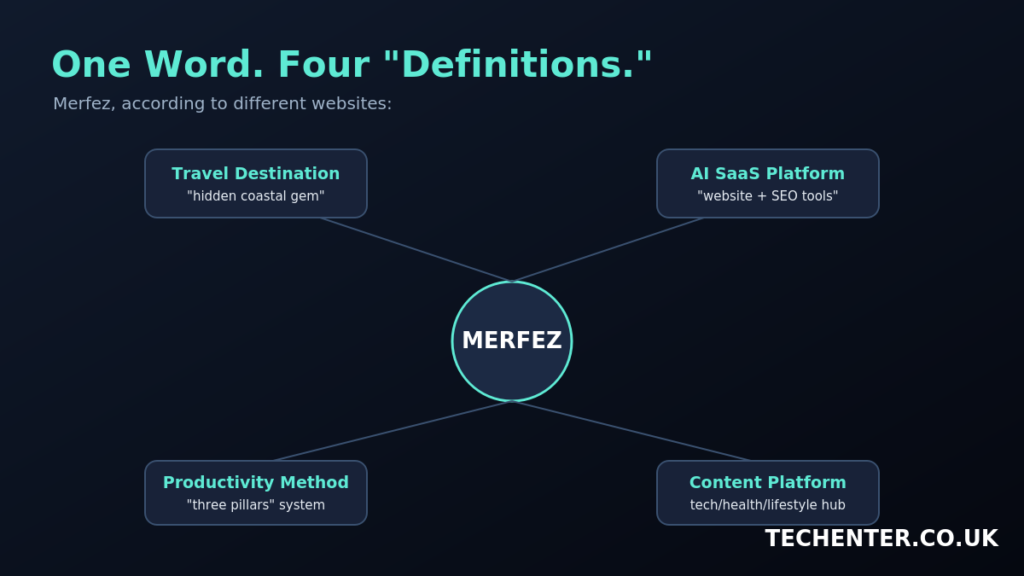
One site calls Merfez a travel destination with beaches and old ruins. Another says it’s an AI-powered SEO tool. A third describes it as a “productivity methodology” built on three pillars. A fourth treats it as a general content platform covering tech, health, and lifestyle.
Here’s the honest answer: Merfez isn’t a real, established product, place, or concept. It’s a keyword that a cluster of content sites have each defined on their own terms, in the same few months, with no agreement between them. This article explains what’s actually going on, why it happens, and how to spot the same pattern the next time an unfamiliar “trending” word shows up in your search results.
What Is Merfez? The Short Answer
There is no single, verifiable source — no company registration, no product page, no established brand, no encyclopedia entry — that defines Merfez consistently. When a term has one real meaning, independent sources tend to converge on it. Merfez does the opposite: the more you read about it, the less agreement you find.
That inconsistency is itself the most useful fact about the word.
Why Does Every Site Define Merfez Differently?
Here’s a rough sample of what’s actually being published under the Merfez name:
A Travel Destination”
Some articles describe Merfez as a hidden coastal town with rich history, local festivals, and street food worth trying — without ever naming an actual country, region, or map coordinates.
An AI-Powered SaaS Platform”
Other pages describe Merfez as software with a website builder, SEO tools, and content-generation features, aimed at developers and marketers.
A Productivity Methodology”
A different set of articles frame Merfez as a philosophy for work and life, built around minimalism, adaptability, and “intentional” design choices.
A Multi-Niche Content Hub”
Still others present Merfez as a blog-style platform publishing articles across tech, business, health, and home topics, with a mission statement attached.
Four completely different “definitions,” all published as if they were established fact, often within weeks of each other. That’s not how real brands, places, or products get written about.
How This Kind of Content Actually Gets Made
This isn’t a mystery once you understand the incentive behind it. Here’s roughly how a “mystery keyword” article like this comes together.
Step 1: Find (or Invent) a Word With Zero Competition
An invented or extremely rare word has no existing search results to compete with. That means a new article about it can rank on page one almost instantly, since there’s nothing else to outrank.
Step 2: Publish a Confident-Sounding “Definitive Guide”
The article is written in an authoritative tone — headings like “Everything You Need to Know,” bold claims, structured sections — even though there’s no underlying source to verify any of it. Confidence is used as a substitute for accuracy.
Step 3: Add Fake Authority Signals
Many of these articles reference other equally invented terms (“Like Pappedeckel and Seekde…”) to make the word feel like part of a recognized trend, and pad the piece with generic filler about “growing relevance” and “future potential” that could apply to literally anything.
Step 4: Let Curiosity Do the Rest
Once a few of these articles exist, curious readers search the term to find out what it means, which signals to search engines that people are interested — encouraging even more sites to publish their own “definitive” version.
I’ve seen this pattern before with other odd, out-of-nowhere terms that suddenly get a wave of “ultimate guide” articles. It’s a low-effort, low-risk way to grab search traffic, and it works precisely because there’s no real definition to fact-check against.
How to Spot a “Mystery Keyword” Article
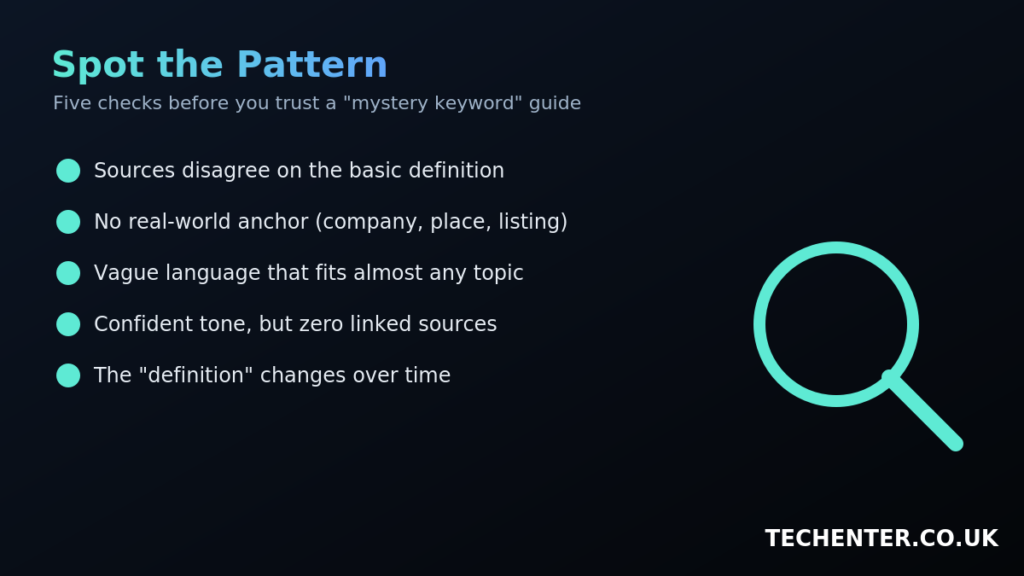
Next time you land on a page explaining an unfamiliar term, run through this quick checklist:
- Check for disagreement. Search the term plus “meaning” or “what is” and open three or four results. If they describe completely different things, that’s a red flag, not a coincidence.
- Look for a real-world anchor. Genuine products have a company name, a pricing page, or app store listing. Genuine places have coordinates, a country, and a Wikipedia entry. If none of that exists, be skeptical.
- Notice vague, swappable language. Phrases like “flexible concept,” “growing relevance,” or “structured approach to efficiency” can be dropped into an article about almost any invented word without changing much.
- Watch for confidence without sources. Real explainer content usually links to something — an official site, a news report, a regulatory filing. Mystery-keyword content rarely does, because there’s nothing to link to.
- See if the definitions shift over time. Revisit the term a few months later. If the “definitive” meaning has quietly changed, it was never definitive to begin with.
Why This Matters
It’s tempting to shrug this off as a harmless SEO trick. Mostly, it is. But it’s also a small example of a bigger problem: it’s now trivial to flood search results with confident-sounding, well-formatted content that has no factual anchor at all. If you can’t tell the difference between a real explainer and an invented one for a low-stakes word like “Merfez,” the same techniques work just as easily on topics that actually matter — health claims, financial products, or reviews of things you’re about to spend money on.
Being able to spot the pattern — disagreement between sources, no real-world anchor, vague filler language — is a genuinely useful skill well beyond this one word.
Conclusion: What’s Known and What’s Not
Merfez has no single, verifiable meaning. It’s been described as a travel destination, an AI tool, a productivity philosophy, and a content platform, often by different sites within the same season — a pattern typical of invented, low-competition keywords built purely to capture search traffic rather than to inform anyone.
If you came here looking for a real answer, that is the real answer: there isn’t one yet, and any article claiming otherwise should be read with a healthy dose of skepticism.
For more information, please visit:Techenter.co.uk