

I’ll be honest with you. A few months back, I had no idea what WRE Inc actually did. I kept seeing the name pop up in industry articles, and I felt a little embarrassed that I couldn’t explain it if someone asked me at a dinner party.
So I did what I always do. I dug in, read everything I could find, and talked to a couple of people who’ve worked with water engineering firms before. This post is the result. If you’re searching for WRE Inc and want a plain-English answer without the jargon, you’re in the right place.
By the end, you’ll know exactly what WRE Inc does, who it works with, and why it matters. Let’s get into it.
What Is WRE Inc. Really?
WRE Inc stands for Water Resources Engineering, Inc. It’s a specialized engineering firm based in San Francisco, and it’s been around since 1989.
Here’s the thing that surprised me most. Unlike big engineering companies that spread themselves across ten different industries, WRE Inc picked one lane and stayed in it: water.
That’s a bold move in a market where everyone wants to be a jack of all trades. But it turns out that staying narrow can actually make you sharper.
Who Started It and Why
A guy named Gustavo Arboleda founded the company back in 1989. He’d already spent years consulting for government agencies and large engineering firms, and he noticed something. Teams with a laser focus on water tended to solve problems faster and with fewer mistakes than generalist teams.
So he built a small group of water specialists instead of a broad civil engineering shop. That original idea still shapes how the company operates today, even as it’s grown.
The Core Services WRE Inc Offers
I like to think of this in three simple stages: plan it, design it, build it right.
Planning and analysis. Before anyone breaks ground, WRE Inc studies how water actually moves. That means flood risk modeling, flow pattern studies, and computer simulations that predict how a system will hold up under stress.
Design work. This is where blueprints become real. The firm designs pump stations, pipelines, reservoirs, dams, and wastewater treatment plants using modern engineering software.
Construction support. Once shovels hit dirt, WRE Inc sticks around to make sure the build matches the approved plans. This step catches costly errors before they become permanent.
A Quick Breakdown of Specialties
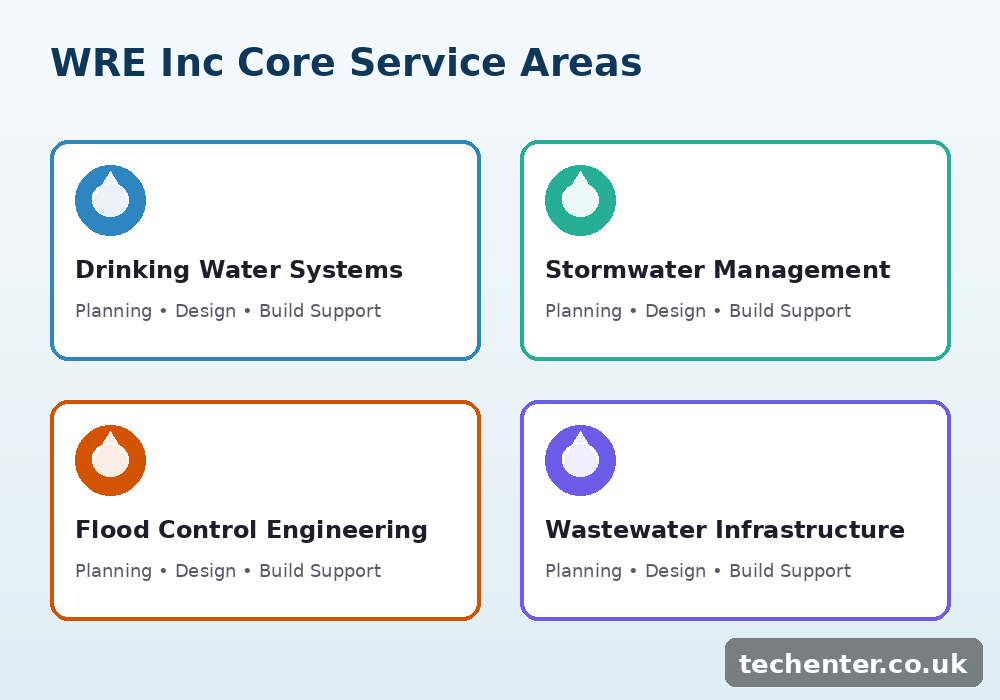
If you want the short list, here’s where WRE Inc focuses most of its energy:
- Drinking water system design
- Stormwater management planning
- Flood control engineering and dam safety
- Wastewater treatment infrastructure
- Recycled water and conservation projects
I really appreciate that last one. Water reuse isn’t flashy, but it’s quietly becoming one of the most important parts of city planning as droughts get more common.
Industries and Clients WRE Inc Works With
You might assume a firm this specialized only works with a handful of clients. Not the case.
WRE Inc serves federal government agencies, city governments, water utilities, private developers, and even other engineering firms that need extra hands on a project. Most of the work happens in Northern California, though the company has completed projects across the U.S. and abroad too.
A few real examples give you a better feel for the scope:
- San Francisco Public Utilities Commission — the firm handled storm damage assessments and erosion control after major water pipelines were exposed.
- Treasure Island Water System — when the U.S. Navy handed this system over to San Francisco, WRE Inc mapped out service connections and flagged safety hazards.
- Golden Gate Park recycled water project — the firm helped design the system that brings treated water to irrigation across several city parks.
- U.S. Bureau of Reclamation — WRE Inc studied ways to improve long-term water delivery reliability through the Madera Canal.
That’s a pretty wide range of clients for a company that only does one thing. It tells you something about the value of specialization.
Why WRE Inc’s Approach Actually Works
Here’s my honest take. In a lot of industries, “specialist” can be a fancy word for “expensive and slow.” That’s not really the vibe I got here.
Because the team only works on water-related projects, they’re not relearning the basics every time a new project lands on their desk. According to the firm’s own site, staying small and repeat-client focused lets them respond quickly when requests come in urgently, since they don’t have layers of bureaucracy to cut through (Water Resources Engineering, Inc., n.d.).
That kind of responsiveness matters more than people realize. Flood damage and pipeline failures don’t wait around for a six-week onboarding process.
The Real Benefits, In Plain Terms
- Deep expertise. Decades of experience in one field beat a little bit of experience in ten fields.
- Faster turnaround. Repeat clients and a tight focus mean less time spent explaining the basics.
- Regulatory comfort. Water infrastructure is heavily regulated, and specialists tend to know the rules cold.
- Long-term thinking. Sustainability gets baked into projects from day one instead of tacked on at the end.
I’ll admit, I didn’t expect a niche engineering firm to feel this relevant to everyday life. But every time you turn on a tap or avoid a flooded street after a storm, there’s a decent chance a firm like this had something to do with it.
How to Learn More or Get Involved
If you’re a city planner, developer, or just someone curious about infrastructure, here are a few practical next steps:
- Check the firm’s official site for current project case studies and contact details.
- Look into local water utility board meetings if you want to see this kind of work discussed publicly.
- Compare a few specialized engineering firms before choosing one for a project, since focus really does vary by company.
For more background on how water systems affect city planning, check out our related post on how urban infrastructure shapes growth and our guide to understanding local water utility services.
Wrapping It Up
So, what’s the big takeaway? WRE Inc is a specialized water resources engineering firm that has built its reputation by staying narrowly focused since 1989. It plans, designs, and supports construction on everything from drinking water systems to flood control projects, and it works with everyone from city governments to private developers.
Honestly, researching this gave me a new appreciation for the quiet infrastructure work that keeps our cities running. It’s not glamorous, but it’s essential.